Chartered Institute
of Linguists
From prison to page

How the translators of a prison memoir rendered the sprawling text, smuggled out on scraps of paper, in English
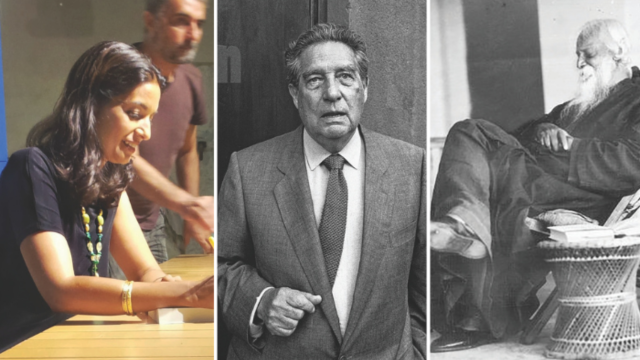
 Mahvash Sabet (pictured left) is an Iranian prisoner of conscience. First arrested in 2008, she was given a ten-year sentence because she was a Bahá’í, together with her six colleagues on the Yaran-i-Iran – an ad hoc group caring for the Iranian Bahá’í community. The Bahá’ís are the largest religious minority in Iran, and the most persecuted.
In 2022, Sabet was sentenced to another ten years, and although she was granted medical furlough for heart surgery in 2024, she remains a prisoner at grave risk. Her first collection of poetry, Prison Poems, was published in English in 2013, winning her recognition as the 2017 PEN Pinter Poetry Prize Writer of Courage. She has also published Raha (‘More Prison Poems’) and Hekaya-e Asheghi (‘A Tale of Love’) in Persian.
Her prison memoir, Open Wide the Doors, was translated by Azita Mottahedeh and Bahiyyih Nakhjavani over five years from 2018 to 2022. They had worked together previously on translations of Bahá’í writing, and Nakhjavani had also translated Prison Poems. They discuss the process of translating and editing the lengthy Persian text, and the linguistic and emotional challenges involved.

Open Wide the Doors
Azita Mottahedeh: We did not know what we were getting into when we began. Mahvash had been scribbling on scraps of paper for at least seven years in prison and had accumulated a mountain of notes and notebooks. When she was freed in 2017, she began transcribing these because she knew it was only a matter of time before she might be arrested again. She sent the Persian text to me page by page, and I forwarded the English draft to Bahiyyih in the same way. By the time I reached the last of the 750 pages, five years had passed and Mahvash was back in prison.
Bahiyyih Nakhjavani: Once Mahvash found a pen, about three years after her arrest, she wrote on anything she could find: gossamer thin tissue paper spliced in half, pages from poetry books and margins of torn-up newspaper used in the toilets. To hide these from the guards, she stuffed them inside her bra, slept on them, and finally managed to smuggle them out of Evin Prison bit by bit.
AM: While we were working on the text, Covid happened and there were many interruptions. We were also facing a moral dilemma: how to reconcile our responsibility towards Mahvash with our consciousness of the danger this book might pose for her and other Bahá’ís. And so it was not until she was arrested again in 2022 – not until she had nothing left to lose – that the work resumed in earnest.
That year, the ‘Women, Life, Freedom’ movement erupted on the streets of Tehran, and a separate campaign was launched to honour the Bahá’í women who were hanged for their beliefs in 1983. The time was clearly ripe to play our part in bringing Mahvash’s story to an English-speaking audience.
Bringing the story to an English-speaking audience
BN: We followed our established work patterns. Azita is the Persian expert and I the English, but she was educated in the UK and I understand Persian too. So we work as a team, filling in each other’s gaps like pieces of a jigsaw puzzle. Azita is a transparent translator. She doesn’t intervene a hair’s breadth from the original and is so faithful that she sometimes even retains the Persian syntax, in order not to interpret or interpolate. She usually provides a word for word translation, often with several synonyms to see ‘around’ the meaning. She sends me recordings in Persian, too, because although I understand the language I do not read or write it.
AM: Bahiyyih took this mass of material and turned it into a story. Some of it was too general to carry the story forward, some too repetitive to retain (and how could it not be in the circumstances?). And much of the material had to be reorganised and restructured to follow not only a chronological but a dramatic narrative line. She did everything possible to maintain the style, sentiments, thrill and especially the humour of Mahvash’s writing; I could often hear Mahvash’s voice as I read the English!
BN: Mahvash surely guided us. The first part of her memoir was written differently, because she was recording her arrest and early prison experiences almost three years after they occurred – not in diary form, but in retrospect, looking back over her shoulder. Since she was almost entirely alone during this period, her first-person point of view turned this narrative into a very personal story. The resulting book is based on the first two volumes of five that cover her initial 10-year imprisonment.
AM: We couldn’t see that five-part structure until we had read through the whole. We couldn’t distinguish her voice either, until we had heard the full story. Mahvash has certain characteristic stylistic traits. Her prose is usually spare and colloquial, like much contemporary Persian writing. But she also uses a more classical style at times, with patterns of paired words, rising repetitions and mixed metaphors typical of Persian poetry. When she combines the two, it can be effective, as in her description of spring: “Music was in the air, an exquisite symphony was playing, and all the branches in their shimmering silks were dancing for this prisoner wrapped in her smelly old chador in the back of the car.” At other times she repeats rhetorical questions to build the sense of injustice she is experiencing.
Asking questions
BN: Asking questions is a really important trait of Mahvash’s style, given that her only communication was during her interrogations and the rest of her time was spent in strict isolation. She questions herself. She questions the ants in her cell and conducts an unspoken dialogue with the cockroaches. She often mocks her pedagogical habits, while teaching pretend classes and addressing an imaginary auditorium filled with her compatriots.
AM: There is so much in this book which we found ourselves experiencing as translators, in far less grim circumstances of course. We had to question ourselves, too, about what to keep and what to leave out, about how explicit or implicit to be. But before her second arrest, we were lucky enough to speak to Mahvash on Skype about some of our dilemmas. She was very patient about explaining certain words and phrases. For example, she deployed the same word بند (band) in reference to a section or a ward, and occasionally a passage or a corridor, so we had to choose the ‘right’ English word to reflect a consistent mental architecture.
We learned to respect her avoidance of specifics for security reasons, while keeping the text from becoming overly vague – for example in her remarks about her interrogator. At other times, she candidly confessed that she did not know how to convey certain experiences and gave Bahiyyih carte blanche to find solutions.
One of the more difficult passages was the experience she describes in the dog kennel in Mashhad, where despite being kept in darkness, she finds herself ‘looking’ into the very heart of light. This episode feels mysterious yet familiar, unique and oddly universal. It is also replete with particular meaning for Bahá’ís, who associate the experience with events in Bahá’í history.
Mahvash wanted the book to be accessible to all readers, whether they knew about the Bahá’í Faith or not, so she allowed Bahiyyih to begin with the universal and only gradually hint at the historical associations of this episode. Her humility was a real lesson in artistic detachment. It made us all the more aware of our obligation to protect her voice from being hijacked in translation.
Graphic English vs Persian decorum
BN: This was a real challenge for me when I was looking for the blunt English equivalents of the more decorous Persian circumlocution. One example was in the sequence describing physical torture: Mahvash’s memoir made reference to the vulgar curses that her torturers threw at her, but in the English dialogue these came across as too graphic. Azita and I went back and forth several times before we found a compromise between the English need for the proverbial spade and the Persian preference for hints and approximations.
The Persian language loves ambiguity; it privileges inference over specificity. And while this may be appropriate for poetry and mystic experience, it doesn’t always work in relation to space and time. In the original passage about Evin Prison, for example, Mahvash uses the second-person singular to bring ‘you’, the reader, directly into the prison with her. But the prison she takes ‘you’ into is like a Piranesi sketch, with stairs going up and ending in midair, and corridors twisting and turning in on each other like a Mobius strip.
This surreal world was also weirdly appropriate, because imprisonment for Mahvash is always linked to the inner as well as the outer world. She had not intended to create this effect; indeed, she thought she had written a very precise description of Evin. It was only when I questioned her about which side of the corridor the doors were on, or where exactly the stairs led to, that she realised that what she had in her mind had not quite succeeded in reaching the page!
A book which chose its own title
Once we pinned down the details, the challenge was to convey the psychological prison to the English reader as well. A spatial description was not enough, so I added Mahvash’s commentaries and meditative passages from other parts of the memoir in order to lead the reader step by step from the outer world to an inner one. When I was talking to Mahvash about some of these decisions during our rare Skype conversations before her arrest, she laughed and said: “When you finish, we will translate this whole book back into Persian!”
Communication has been difficult since then. But I have often had the feeling that Mahvash’s text was talking to us. It happened with the title. She didn’t choose it, but after it came to me, with its wonderful affirmative resonance, I found more than 200 references to doors in the text. The book chose its own title!

Azita Mottahedeh is a translator from Persian to English specialising in works about the Bahá’í Faith. Her translations include articles, talks, memoirs, poetry, and lengthy books of philosophy, history and theology.

Dr Bahiyyih Nakhjavani taught English literature and creative writing for four decades. She is the author of four novels and of essays about the Bahá’í Faith, and the co-translator of poetry by Forough Farrokhzad and Mahvash Sabet.
This article has been reproduced from the Autumn 2026 issue of The Linguist. Download the full edition here.